
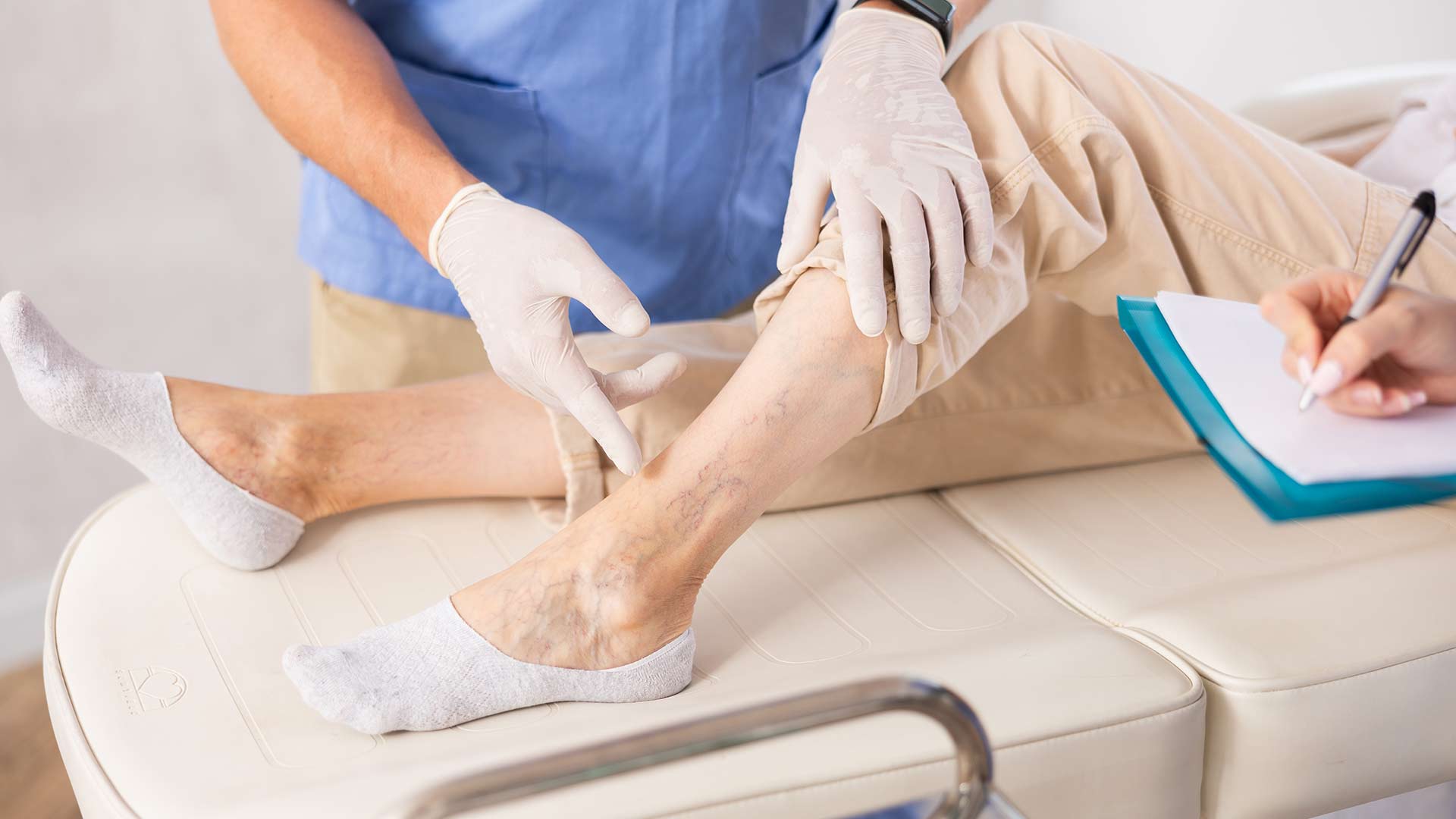
Treatment of reticular varicose veins
There is no person who has not seen vascular meshes or stars on their legs or face – this is nothing more than varicose veins of the subcutaneous veins.
The features of the occurrence of both varicose veins and spider veins or reticular veins are the same – weakness of the venous wall and increased pressure in the veins. In women, reticular varicose veins are much more common, which can be explained by pregnancy and childbirth. It is also worth noting the occupational hazard, in particular, this disease can affect surgeons, teachers, salespeople, flight attendants, etc., that is, those people who spend a significant part of their working time in an upright position, especially if there is a genetic predisposition to varicose veins. Similar changes can appear with age, for example, blue-violet veins in the skin (on the thighs and calves) increase. Increased pressure in small veins that pass to the subcutaneous tissue and skin leads to their increase, both in diameter and in length. These veins begin to twist, curl. This happens because the pressure in the veins is higher than the strength of the venous wall. The venous capillaries that drain into these small veins become stretched and twisted. Such veins can protrude above the surface of the skin, and even a minor injury can cause bleeding.
Reticular varicose veins
Normally, blood moves through veins from the foot to the lungs and heart with the help of a special valve. Such veins are characterized by elasticity and small diameter; they are not visible or can be seen in good lighting in people with a very thin subcutaneous fat layer and, moreover, with very fair and transparent skin.
Reticular varicose veins are more of an aesthetic problem, which, however, does not pose a health threat and rarely leads to complications.
The diagnosis is very easy – a medical examination is enough.
Conditions for the prevention and control of the development of reticular varicose veins and varicose veins in people with a genetic predisposition: normalization of weight, proper nutrition, active lifestyle; we recommend paying attention to swimming. It is necessary to avoid heavy physical work, lifting heavy objects, prolonged static loads, jumping. We especially note the harm of tap dancing – strong heel-to-toe blows lead to the rapid development of varicose veins in people with a genetically weak vascular wall.
It is worth noting the role of knitted clothing, such as: anti-varicose stockings and tights for the prevention of varicose veins in patients at risk. Only a doctor can prescribe the wearing of compression stockings of 1, 2 or 3 degrees of compression, based on medical indicators obtained after examining the patient.
Treatment of reticular varicose veins
Sclerotherapy. The peculiarities of its implementation are the use by the doctor of a special drug that causes local inflammation of the vein with its subsequent sclerosing and narrowing of the vessels and veins (using small needles that are equal in size to the diameter of the capillary). The thinner the capillary, the thinner the needle. The procedure requires special training and a high degree of technical skill. After this procedure, the venous mesh disappears after some time. Often, one procedure is enough to completely solve the problem. But in the case of a large number of capillaries, several procedures are necessary. The procedure is painless, after it the patient can easily walk. You can always contact us with questions about reticular varicose veins.
Laser treatment for reticular varicose veins: Laser therapy works more slowly than sclerotherapy. It is effective when treating tiny spider veins. More than one treatment may be needed, and the treatment can take about a year for the veins to disappear completely.
These two methods are not opposed to each other, they should be used in combination. After sclerotherapy, laser treatment is performed in order to obtain the best result.
Side effects: temporary skin discoloration in the area where sclerotherapy was performed; blistering; temporary minor discomfort in the areas where spider veins were treated.